
In our pursuit of a clearer, more focused mind, we’ve journeyed through the foundational neuroscience of mental resets, strategies to conquer procrastination and digital distractions, and the art of building unshakeable confidence against imposter syndrome. We’ve learned to manage our internal landscapes and optimise our daily output. Yet, a subtle, pervasive force constantly threatens this hard-won clarity: the hyper-connected digital world itself and its assault on our attention.
This isn’t merely about limiting screen time; it’s about reclaiming your attention, your mental energy, and ultimately, your sense of purpose from an environment engineered to hook you. It’s about understanding the sophisticated neurological exploitation at play and implementing strategic, science-backed interventions to reshape your relationship with technology. The goal is to transform chaotic daily experiences into opportunities for mindset mastery and sustained mental clarity. True long-term success and well-being aren’t just about what you do with your time, but how you design your attention and align it with your deeper “why”.
Part 1: The Hidden Cost of Constant Connection: The Brain Drain Epidemic
Our brains, evolved for survival in a natural world, are simply not designed for marathon focus in a digitally saturated environment. The relentless ping of notifications and the endless scroll are not accidental; they are engineered to exploit our neurobiology.
Consider the consequences:
- Cognitive Drain: Background app notifications can lead to a 10 IQ point reduction during critical tasks, and continuous context switching can result in a 40% drop in complex problem-solving efficiency. Even the mere presence of devices, unused, can reduce recall accuracy by 20% – known as the “brain drain effect”.
- Engineered Addiction: Social media platforms use variable reward schedules, triggering dopamine surges similar to slot machines. Endless scroll architecture deliberately removes stopping cues, inducing a flow state that keeps you hooked. This “validation economy” activates the brain’s reward centre (the nucleus accumbens) leading to obsessions with likes and shares. Whistleblowers have even stated that these systems were built knowing they would erode mental health.
- Nomophobia: Many of us suffer from nomophobia, an intense anxiety when separated from our devices.
- Physical Tolls: The average US adult spends over 10 hours daily on screens, accumulating to 8.7 years of waking life, leading to significant physical tolls like digital eye strain and “text neck”.
- Economic Liability: This isn’t just a personal cost; knowledge workers spend an estimated 65% of their week managing distractions, costing the global economy $1.8 trillion annually.
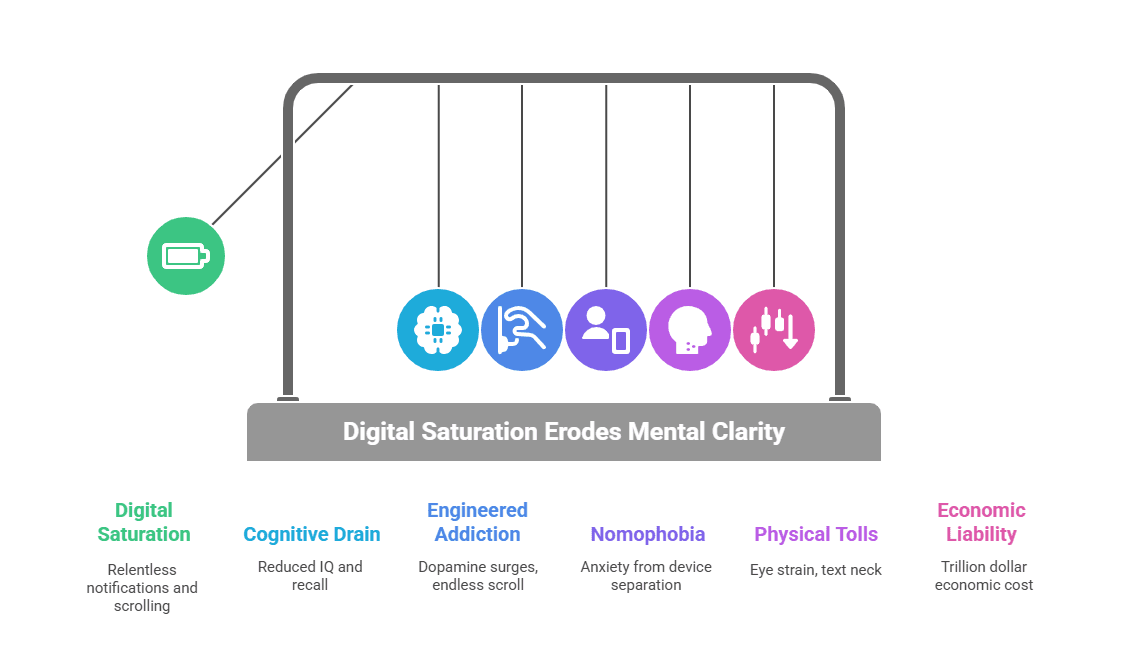
This constant digital hum fragments our attention, leading to overwhelm and procrastination, and directly impacts our mental clarity.
Part 2: The Reclamation Framework: Building Digital Resilience
True freedom from digital overload comes from strategically rewiring your relationship with technology.
- Behavioural Rewiring: The Hobby Prescription Hobbies are not distractions; they are cognitive antidotes. Engaging in tactile creation or playing instruments boosts calming neurotransmitters (GABA) significantly more than passive scrolling. Activities like woodworking, rock climbing, or memoir writing can engineer flow states and rebuild attention spans. By auditing wasted screen time and replacing scroll sessions with purposeful hobbies, individuals can significantly reduce anxiety and reclaim hours.
- Digital Surgery: The App Elimination Protocol This requires strategic precision:
- Audit & Triage: Identify your top time-sinks. Immediately delete infinite scroll apps (e.g., TikTok, Instagram Reels). Neuter notifications from essential messaging apps like Slack or WhatsApp. Restructure your phone by moving essential utilities to the home screen and burying social media apps in folders, adding biometric locks or 24-hour “download cool-off” rules.
- Withdrawal Plan: Use grayscale mode (reduces dopamine hits by 43%) for the first few days. Install app blockers (e.g., Freedom) to block distracting websites during focus hours.
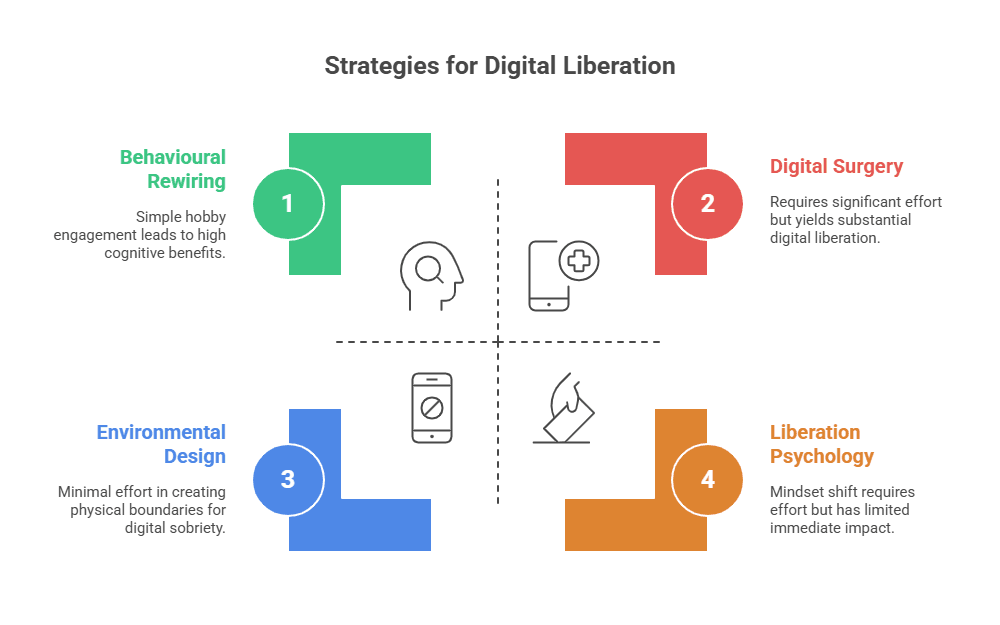
- Environmental Design: Spatial Boundaries for Digital Sobriety Create physical separation to reduce temptation:
- The 10-Foot Rule: Keep phones at least 10 feet away during meals, deep work sessions, and intimate conversations.
- Bedroom Sanctuary Protocol: Charge your phone in a hallway or another room, not beside your bed. Use a standalone alarm clock and install red-light bulbs to promote melatonin. Place an analog book on your nightstand as an alternative input.
- Workplace Arsenal: Utilise “Focus Pods” or soundproof phone booths for scheduled digital checks, or even enterprise-grade signal jammers in meeting rooms to enforce phone-free zones.
- The Liberation Psychology: Shifting Your Digital Identity True freedom involves changing your mindset around technology:
- Move from FOMO (Fear Of Missing Out) to JOMO (Joy Of Missing Out). Actively curate “analog adventures” and track the experiences gained (e.g., “Learned guitar chord” is more valuable than “Saw influencer post”).
- Adopt a “Device as Tool, Not Toy” mindset. Apply the “surgeon’s rule” – only remove your phone from your pocket for pre-defined tasks, treating it like a tool for a specific job, not a source of endless entertainment.
Part 3: Purpose-Driven Action: Anchoring Your Mind for Long-Term Success
Digital liberation provides the space; a strong sense of purpose provides the direction. Purpose isn’t a vague ideal; it’s a neurobiological catalyst that activates your brain’s reward circuits and assigns meaning to your goals.
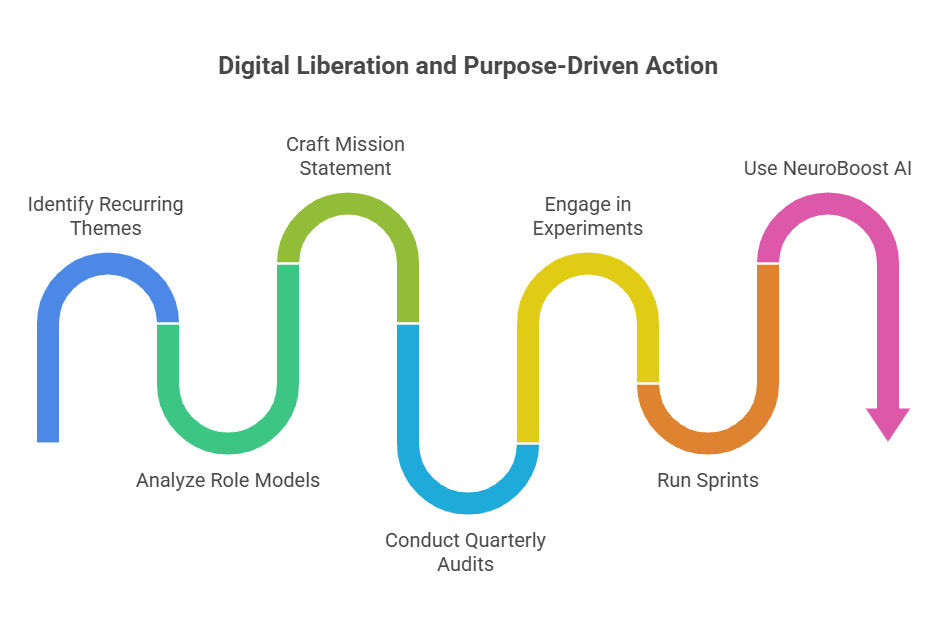
- Decoding Your “Why”: Your brain’s medial prefrontal cortex (mPFC) identifies recurring themes in experiences by linking memories to emotional outcomes, helping you decode your deeper purpose.
- Autobiographical Mining: Reflect on “peak experiences” where you felt truly fulfilled. What were you doing? What common thread connects them (e.g., creativity, problem-solving, connection)?.
- Hero Analysis: List traits of role models you admire. Your mirror neurons encode admired behaviours as aspirational templates.
- Crafting a Neuro-Aligned Mission Statement: A clear mission statement acts as a cognitive schema, priming your brain’s reward centres to tag aligned actions as rewarding.
- “5 Whys” Framework: For any interest, repeatedly ask “Why?” until you hit a core value (e.g., “I love coding” → “It lets me solve systemic problems”).
- Two-Sentence Heuristic: Draft a concise statement of your purpose, focusing on why you do what you do.
- Dynamic Purpose: Evolving with You: Your mPFC constantly updates goals based on new experiences. Clinging to outdated missions can suppress neurogenesis, stifling growth.
- Quarterly Audits: Revisit your mission every 90 days. Note shifts in what energises or drains you.
- Branching Experiments: Allocate time (e.g., 10% of your free time) to explore tangential interests. Novelty spikes dopamine, revealing hidden affinities.
- The Action-Insight Loop: Purpose isn’t found through introspection alone; it’s clarified through engaged experimentation. Pursuing “provisional goals” can lead to greater clarity than over-planning.
- Run Sprints: Adopt a potential purpose-related habit for a few weeks (e.g., volunteering weekly). Monitor if it feels like “want-to” or “should-do”.
- Predictive Coding: After each experiment, ask: “Did this activity expand my sense of possibility or contract it?”.
NeuroBoost AI, with its personalised mindset tips tailored to your current mood and goal, directly supports this process. It acts as a “personal focus coach powered by AI” to help you align your daily mental resets with your broader, purpose-driven objectives.
Conclusion
The journey to lasting mental clarity and peak performance culminates in achieving digital freedom and aligning your actions with a deeply held purpose. By understanding the insidious ways digital environments hijack your attention and by systematically implementing strategies for digital resilience, you reclaim valuable cognitive space. Simultaneously, by meticulously mapping and refining your purpose, you imbue your daily actions with profound meaning, transforming mundane tasks into steps towards a fulfilling vision.
This isn’t about rigid deprivation or an exhaustive search for a single, fixed purpose. It is about conscious, intentional design – becoming the architect of your attention and the curator of your purpose. By weaving these practices into your life, you empower yourself to beat stress, stay focused, and feel better, anytime and anywhere. You are not merely coping with the modern world; you are unshackling your mind and directing your invaluable attention towards what truly matters, creating a life of sustained well-being, impactful action, and unshakeable momentum.
Visit Neuroboost AI today and reset your mind in 5 minutes a day