
In our journey to cultivate an unchained mind, we’ve systematically tackled internal battles like procrastination, imposter syndrome, and the pervasive grip of digital distractions. We’ve explored how to recalibrate our brains for focus, build unwavering confidence, and reclaim our attention from a hyper-connected world. Now, we turn our gaze outward to the inevitable: obstacles.
Life’s path is rarely smooth. Whether it’s a critical project roadblock, an unexpected personal setback, or a sudden market shift, obstacles are constant. Yet, the true measure of success isn’t avoiding these challenges, but transforming them into catalysts for profound growth and unwavering resilience. This isn’t about simply enduring hardship; it’s about actively redesigning your relationship with adversity, leveraging neuroscience-backed strategies to emerge stronger and more capable than before.
Part 1: The Paradox of Obstacles: Unearthing Hidden Value
Our default response to an obstacle is often negative: frustration, fear, or overwhelm. However, beneath the surface, every challenge holds a dual nature – it is both a demanding force and a transformative opportunity. By consciously seeking this positive duality, you fundamentally alter your experience of adversity.
Consider these profound, often unseen, benefits that obstacles deliver:
- Accelerated Learning & Growth: Pressure and difficulty are potent teachers. Navigating complex problems or demanding new skills forces you to learn and adapt, yielding insights unavailable during smooth sailing.
- Fortified Self-Esteem & Self-Efficacy: Successfully navigating, or even making significant progress against, a challenge provides irrefutable evidence of your capabilities. Each “win,” no matter how small, reinforces your belief in your ability to handle future difficulties, leading to a deeper sense of self-worth.
- Deepened Relationships & Empathy: Shared adversity often forges the strongest bonds. Facing obstacles together reveals true allies, deepens existing connections through mutual support, and releases bonding hormones like oxytocin. Your own struggles can also cultivate greater empathy for others.
- Clarity & Prioritisation: Scarcity of time, energy, or money, often imposed by obstacles, forces conscious allocation of resources. The “fog of the everyday” clears, revealing what is genuinely essential for your well-being and purpose.
- Innovation & Resourcefulness: When the obvious path is blocked, constraints breed creativity. Obstacles force you to find novel solutions, use resources in unexpected ways, and think outside the box.
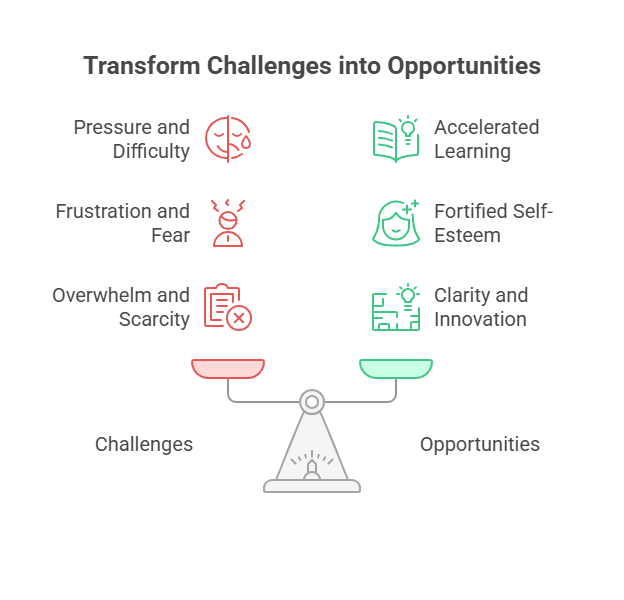
In essence, obstacles are not purely subtractive; they are transformative exchanges. You invest effort, discomfort, and resources, but the potential returns—growth, self-knowledge, resilience, connection, clarity, and innovation—are the very currencies of a flourishing life.
Part 2: The Art of Strategic Perception: Reframing Your Reality
Your interpretation of an obstacle, rather than the obstacle itself, dictates your response. Mastering this perception is a core skill for unlocking resilience.
Follow this three-step protocol to shift your perception and foster a growth mindset:
- Identify & Capture the Initial Narrative: When an obstacle arises, immediately acknowledge your immediate thoughts and feelings. Ask yourself: “What is my immediate thought about this situation?” (e.g., “This is a disaster”) and “What meaning am I assigning to this obstacle?” (e.g., “It means I’m a failure”). Write these down to externalise them.
- Interrogate the Thought: Challenge the validity and helpfulness of your initial perception. Ask:
- “What’s the actual evidence for this thought, and what’s the evidence against it?”.
- “Is this thought truly accurate, or is it an exaggeration?”.
- “Is this thought helping me move towards my goal or away from it?”.
- Reframe & Make Meaning: Actively seek a more empowering narrative. Consciously ask:
- “What potential for growth does this obstacle hold?”.
- “What might I learn about myself or others?”.
- “Could this force a positive change I’ve been avoiding?”.
- Shift from a victim mentality (“This is happening to me”) to one of agency (“This is happening; how will I respond?”).
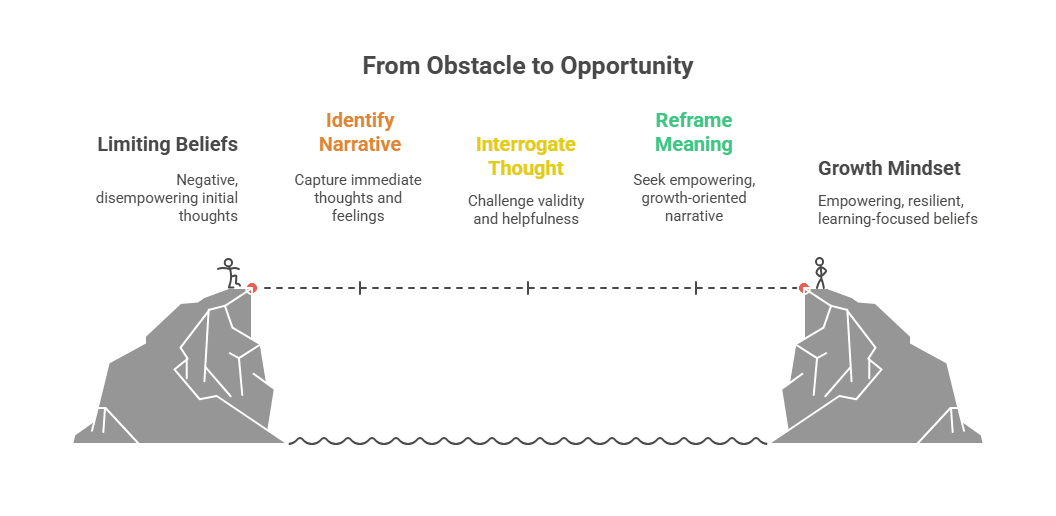
Align your actions with this new frame. If you’ve reframed an obstacle as a learning opportunity, take concrete steps to learn. Act as if you believe the new perception, which accelerates neuroplastic shifts. Track and celebrate micro-wins to reinforce that effort leads to progress. This is an ongoing process of “mental hygiene”.
A Growth Mindset is crucial here: viewing difficulty as part of learning, not proof of failure. Praise your effort, strategy, and perseverance, not just outcomes. Learn from criticism by separating feedback from your identity.
Part 3: Strategic Action: Navigating Your Sphere of Influence
Not all aspects of an obstacle are within your control. Effective action requires understanding and operating within your Sphere of Influence:
- Direct Control: These are areas where you have absolute power – your effort, attitude, responses, and specific habits (e.g., exercise, communication style). This is your “sovereign territory” where true progress happens.
- Indirect Influence: Here, you can exert pressure, persuasion, or impact through your choices, but the ultimate outcome depends on external factors (e.g., negotiating with a colleague, influencing a team project). Focus on doing your part excellently and detach from demanding specific outcomes.
- Zero Control: This realm includes everything outside your influence (e.g., market shifts, global events, other people’s actions).
Focus your energy on your Direct Control, then strategically engage with your Indirect Influence, and radically accept what falls into the Zero Control sphere.
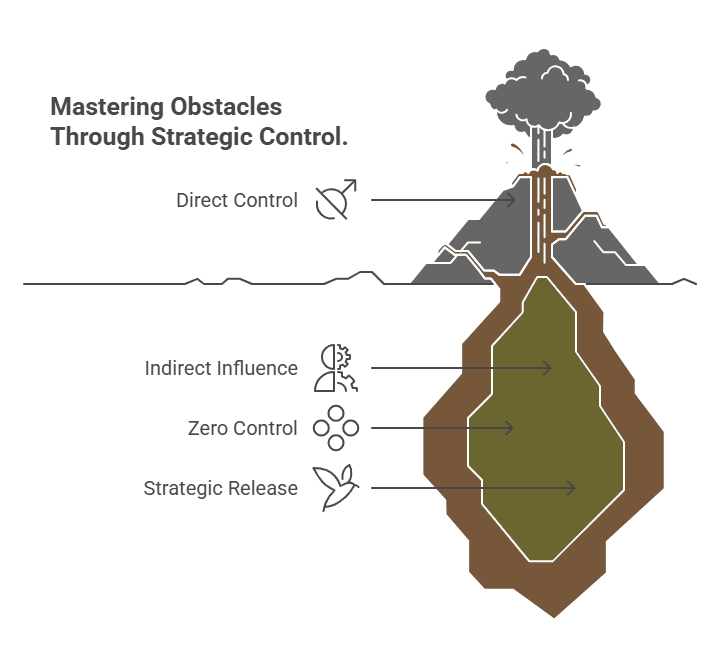
A vital, often painful, skill is strategic release – knowing when to let go of non-viable obstacles. This is not quitting due to fear, but a deliberate, values-driven decision based on assessing the facts, resource cost, and probability of success. Reframing mantras can help you release the urge to control what you cannot (e.g., “I release my need to control this outcome,” “I focus my energy only where I have agency”).
Part 4: Engineering Unbreakable Resilience
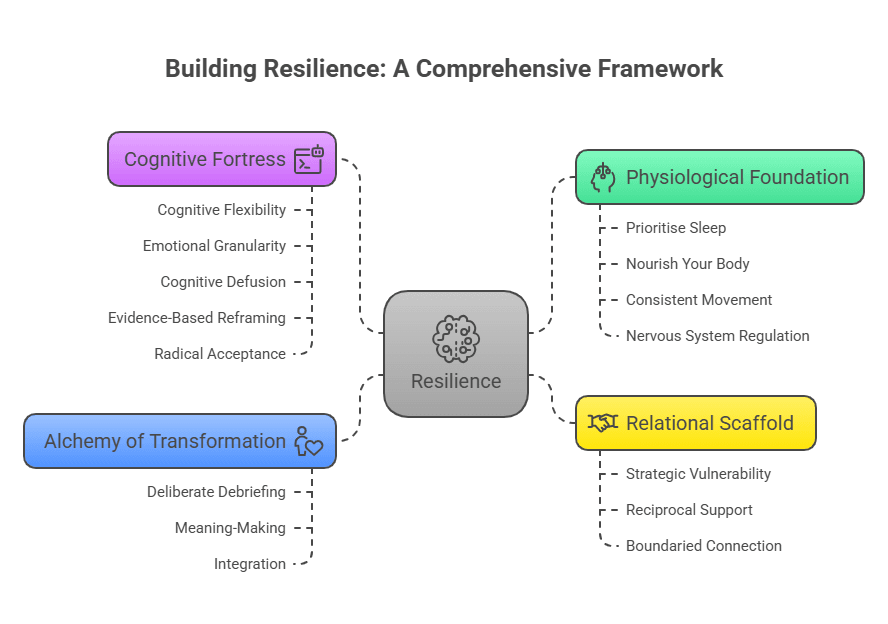
Resilience is your capacity to adapt and recover from challenges. It’s fundamentally rooted in nervous system regulation and is built upon three interdependent capacities:
- The Physiological Foundation: Building Your Biological Buffer
- Prioritise Sleep: 7-9 hours of quality sleep is the most potent recovery tool and essential for nervous system regulation.
- Nourish Your Body: Prioritise wholesome, nutrient-dense foods and stay hydrated. Avoid erratic eating patterns and excessive sugar/caffeine.
- Consistent Movement: Engage in daily physical activity to reduce stress hormones and improve brain chemistry.
- Nervous System Regulation: Practice techniques that activate the parasympathetic nervous system (rest-and-digest):
- Diaphragmatic Breathing: Deep, slow belly breaths (e.g., 4-7-8 pattern: inhale 4s, hold 7s, exhale 8s).
- Vagal Tone Stimulation: Hum, sing, gargle, or apply cold exposure (e.g., splashing face with cold water, brief cold shower).
- Grounding Techniques: Use sensory awareness (e.g., 5-4-3-2-1: identify 5 things you see, 4 you feel, 3 you hear, 2 you smell, 1 you taste) to anchor yourself in the present moment during overwhelm.
- The Cognitive Fortress: Rewiring Your Thought Architecture
- Cognitive Flexibility: Adapt your thinking, reframe situations, and challenge automatic negative thoughts (ANTs).
- Emotional Granularity: Move beyond vague feelings like “bad” to precisely name your emotions (e.g., frustrated, anxious, ashamed). Naming reduces intensity.
- Cognitive Defusion: Observe thoughts without fusing with them. Instead of “I’m a failure,” notice “I’m having the thought that I’m a failure”. Label thoughts (e.g., “Ah, there’s the ‘catastrophising’ story again”).
- Evidence-Based Reframing: Actively challenge ANTs by gathering evidence for and against them, generating alternative perspectives, and adopting realistic, empowering beliefs.
- Radical Acceptance: Acknowledge painful realities without resistance or judgment.
- The Relational Scaffold: Leveraging Connection as a Force Multiplier
- Strategic Vulnerability: Share your struggles authentically with 2-3 trusted allies. Clearly state what support you need (e.g., “I need to vent,” “I need advice”).
- Reciprocal Support: Offer support to others; helping activates your own reward pathways and reinforces competence.
- Boundaried Connection: Limit time with chronically negative individuals and communicate your needs clearly to protect your energy.
The Alchemy of Transformation: To integrate these practices and truly transform obstacles into fortitude, engage in:
- Deliberate Debriefing: After a challenge, conduct a “transformation autopsy”. Objectively recount what happened, what worked, what didn’t, and what you learned about yourself, others, and resilience. Document these insights.
- Meaning-Making: Consciously craft a narrative of how the challenge fits into your larger life story as a catalyst, not just a catastrophe. Actively seek the “gift” within the adversity.
- Integration: Update your identity (e.g., “I am someone who can navigate challenges”). Codify new practices learned into your daily life. Share your wisdom with others to consolidate knowledge.
This process builds antifragility, meaning you become stronger because of volatility and stress, not just resilient to them. The Resilience Flywheel involves consistent micro-exposure to challenges, applying and refining your tools, celebrating micro-wins, and learning from setbacks, leading to continuous growth. Remember, perseverance is intelligent, adaptable effort, while stubbornness is blind persistence on an unviable path.
Conclusion
The journey to an unchained mind isn’t just about managing internal states; it’s about transforming your capacity to meet external challenges. By embracing the paradoxical nature of obstacles, strategically shifting your perception, focusing your action within your sphere of influence, and engineering unbreakable resilience, you turn adversity into your greatest asset.
NeuroBoost AI, with its personalised mindset tips tailored to your current mood and goal, acts as a “personal focus coach powered by AI”. It can support this process by helping you cultivate the mindset shifts and build the consistent practices necessary to beat stress, stay focused, and feel better, anytime and anywhere, even when facing life’s inevitable obstacles. You are not merely coping with the modern world; you are unshackling your mind and directing your invaluable attention towards what truly matters, creating a life of sustained well-being, impactful action, and unshakeable momentum.
Visit Neuroboost AI today and reset your mind in 5 minutes a day