

In our modern, fast-paced existence, where the relentless pursuit of focus often feels like an uphill battle, you’ve already explored the foundational neuroscience of a mental reset and strategies to conquer procrastination and digital distractions. However, another insidious challenge often lurks beneath the surface of success: the feeling of being a fraud, despite evidence of your accomplishments. This is Imposter Syndrome, a pervasive internal narrative that hijacks our mental clarity, stifles growth, and prevents us from achieving our full potential.
This isn’t about simply “trying harder” or admonishing yourself for perceived inadequacy. Instead, it is about understanding the sophisticated psychological and neurological mechanisms at play within your own brain. By comprehending how your mind responds to internal doubts and external setbacks, you can implement strategic, science-backed interventions to reclaim your self-worth, foster authentic confidence, and cultivate a truly resilient mental state. The goal is to reshape your internal landscape, transforming chaotic daily experiences into opportunities for mindset mastery and sustained mental clarity.
Part 1: The Hidden Epidemic: Demystifying Imposter Syndrome
Imposter Syndrome is often misunderstood as a simple character flaw or a lack of self-esteem, but it is, in fact, a complex psychological behaviour pattern. It’s a “hidden epidemic” where you persistently doubt your intelligence, skills, or talents despite objective evidence of your competence, leading to an internal fear of being “exposed” as a fraud.
Imagine a talented architect named Thomas who consistently works 70-hour weeks, refusing to delegate, believing his worth hinges on flawless execution and doing everything himself. He fears his inevitable “unmasking” is just around the corner. This persistent fear and self-criticism are hallmarks of Imposter Syndrome, leading to chronic stress, anxiety, and burnout.
Key characteristics often include:
- Persistent Self-Doubt: A relentless questioning of your intelligence, knowledge, and problem-solving abilities, even in areas where you demonstrably excel.
- Attributing Success to External Factors: Believing accomplishments are due to luck, timing, or others being “fooled” or overly kind, rather than your own efforts or skills.
- Fear of Exposure: An intense, underlying dread that your perceived “fraudulence” will eventually be discovered.
- Discounting Achievement: Minimising past accomplishments, like a successful project, by thinking “The team carried me; I just got the credit”.
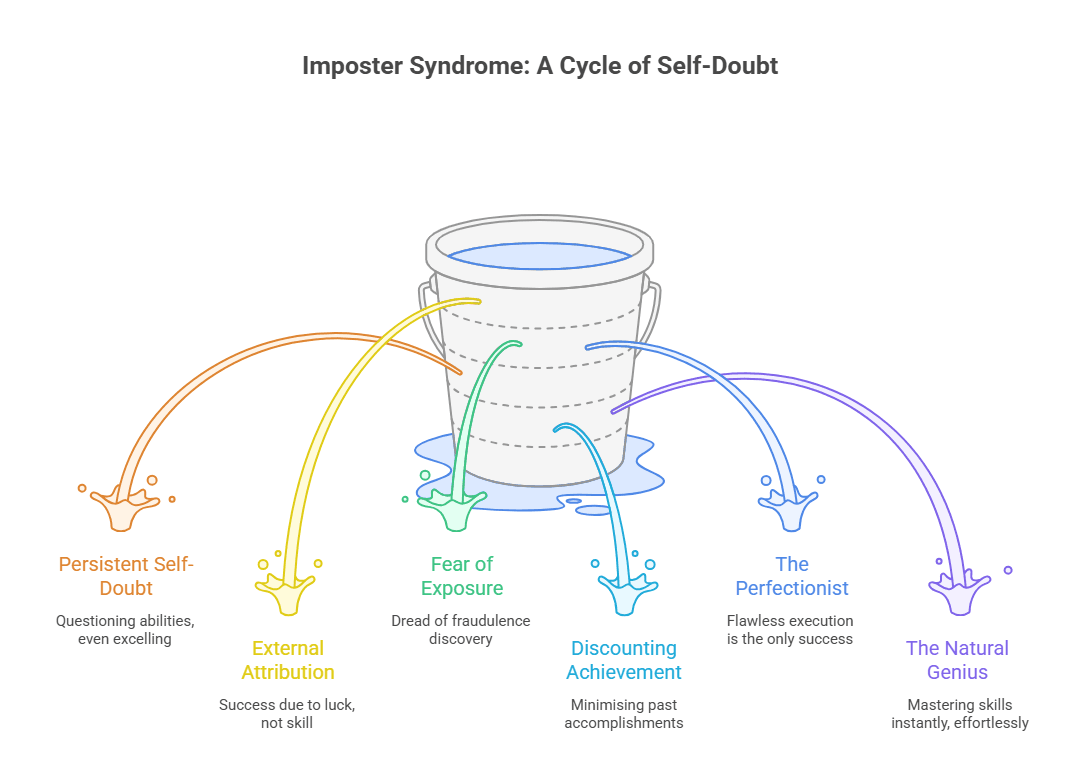
Dr. Valerie Young, a leading expert, identifies five distinct competence types or “flavours” that shape how Imposter Syndrome manifests:
- The Perfectionist: Believes anything less than flawless execution is total failure. This can lead to endless tweaking and delaying actions.
- The Natural Genius: Believes they should master new skills instantly and effortlessly. Struggling feels like proof of inadequacy.
- The Soloist (Rugged Individualist): Equates asking for help with failure and inadequacy, refusing to delegate and often overworking to handle everything alone.
- The Expert: Feels they must know everything about their field. They delay taking action or speaking up until they feel 100% qualified, which is often never.
- The Superhero: Bases their competence on their ability to “do it all” perfectly across multiple domains simultaneously, pushing themselves to extreme limits.
Understanding these “flavours” and the roots of your imposter narrative—whether from early family dynamics, cultural values, or significant life transitions—is the first crucial step towards disarming it.
Part 2: Cultivating Unshakeable Confidence: Daily Practices
Building authentic confidence requires active transformation and consistency.
- Comparison Detox: Escaping the Social Mirror The curated highlight reels on social media are “imposter syndrome’s jet fuel”. To combat this:
- Acknowledge the Thief: Recognise comparison as a choice that steals your joy and confidence.
- Reframe “The Competition”: Shift from “They are better than me” to “What can I learn from their approach?” or “Their success doesn’t diminish mine”.
- Interrupt & Redirect: When comparison strikes, mentally shout “STOP!” and immediately redirect focus to your own progress, unique value, or goals.
- Curate Your Inputs: Ruthlessly mute or unfollow accounts that trigger inadequacy and minimise contact with “Energy Vampires” (chronic complainers).
- The Self-Care Advantage: Fortifying Your Foundation Confidence requires a resilient foundation of physical and mental well-being.
- Physiological Regulation: Prioritise exercise (30 mins daily movement), sleep (7-9 hours of quality sleep in a sanctuary environment), and nutrition (focus on whole foods, protein, complex carbs).
- Mindset Reset: Practice mindfulness/meditation (5 mins daily guided meditation) to observe thoughts without judgment, and engage in nature immersion (20+ mins in green space daily) to reduce stress and boost cognitive function.
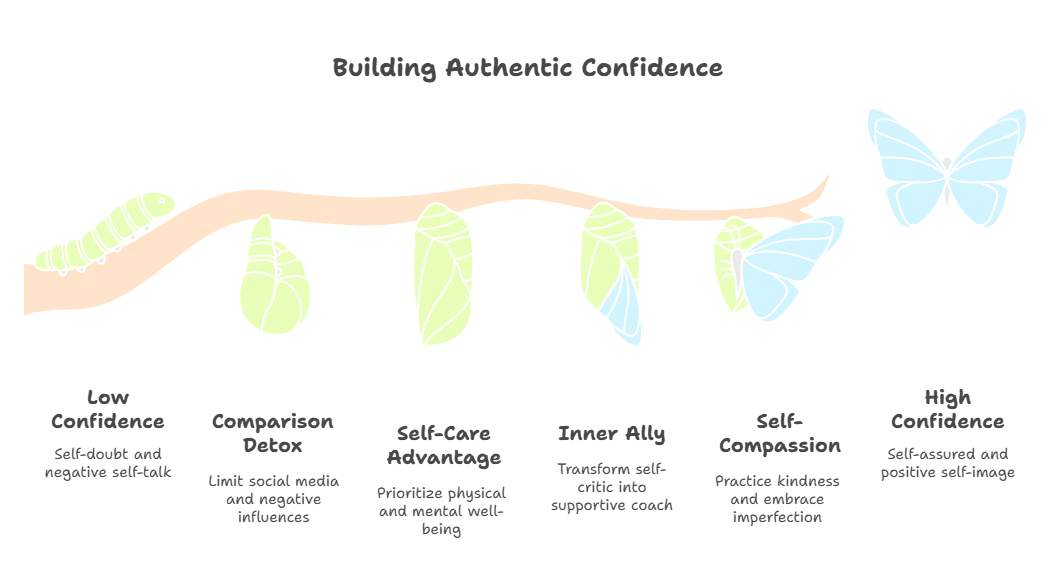
- The Inner Ally: Transforming Self-Talk from Critic to Coach Your internal narrator profoundly shapes your reality.
- Catch the Critic: Jot down every self-critical thought verbatim to notice patterns and triggers.
- Interrogate the Evidence: For each critical thought, ask: “What’s the actual, objective evidence for this?” “Is this thought helpful or harmful?” “Would I say this to a friend?”.
- Reframe with the “Coach Voice”: Replace critical thoughts with supportive, evidence-based, and action-oriented language. For example, instead of “You’re going to fail spectacularly,” tell yourself, “This is challenging. I’ve prepared well. I’ll focus on my key points and handle questions calmly”.
- Anchor in Evidence: Create a “Confidence Portfolio” (a digital or physical folder) where you collect positive feedback, awards, and summaries of successful projects. Review it daily, especially before triggering events.
- The Radical Power of Self-Compassion: Your Armor Against Perfectionism Self-compassion means treating yourself with the same kindness and understanding you’d offer a struggling friend, acting as an antidote to perfectionism.
- Three Core Components: Practice self-kindness (soothing yourself in failure), recognise common humanity (imperfection is universal), and cultivate mindfulness (observing painful thoughts without being consumed).
- Practical Self-Compassion Breaks: When triggered, pause, place a hand on your heart, acknowledge the pain, remind yourself it’s human, and offer kindness.
- Embrace “Good Enough”: Define objective criteria for success before starting, then release the need for unnecessary perfection. “Good enough” liberates action, whereas perfectionism paralyses.
Part 3: The Alchemy of Adversity: Turning Failure into Fortitude and Building Discipline
For those battling Imposter Syndrome, failure often feels like catastrophic proof of inadequacy. However, failure is not a verdict; it’s data.
- Failure is Data, Not Verdict: The Failure Autopsy Instead of dwelling on “I messed up,” conduct an objective “autopsy”.
- Describe the Event: Factually recount the situation without judgmental language.
- Identify Controllable and Uncontrollable Factors: List what you influenced and what was external.
- What Worked / What Didn’t Work: Objectively identify successes and shortcomings.
- Extract Key Learnings: Based on controllable factors, derive concrete lessons (e.g., “Need clearer milestone checks”).
- Craft a Reframe Statement: Create an evidence-based reframe that highlights learning and capability, such as “While Project X missed its deadline… key learnings… will strengthen future campaigns”. This shifts your perception from “I failed” to “This outcome provides information for my next attempt”.
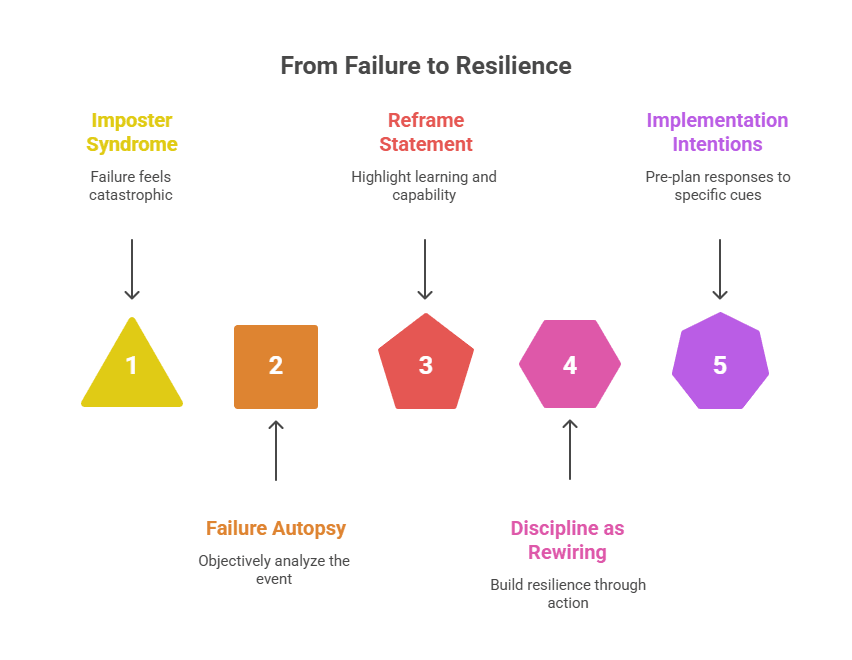
- Discipline as Neural Rewiring: Building Resilience Through Action Discipline isn’t just about willpower; it’s about systematically rewiring your brain. Every time you act despite discomfort, you’re building and strengthening new neural pathways.
- The 5-Minute Rule: Commit to working on a dreaded task for just 5 minutes. This reduces perceived threat, bypasses initial resistance, and often builds momentum to continue longer.
- Implementation Intentions: Transform vague intentions into concrete, pre-planned responses to specific cues using the “If-Then” formula: “IF [Situation/Time], THEN I will [Specific Action]”. For example, “IF I feel anxious, THEN I will take three breaths”.
- The Resilience Flywheel: Small, consistent actions and learning from setbacks build a perpetual cycle of resilience. Each micro-challenge overcome builds “muscle memory” for bigger ones. This process helps your brain treat slip-ups as data points, not failures.
Conclusion
The journey to building unshakeable confidence and resilience begins with unmasking the inner critic of Imposter Syndrome. By understanding its subtle forms, actively detoxing from harmful comparison, relentlessly practising self-care, and transforming self-talk from critic to coach, you build an authentic, evidence-based self-worth. Furthermore, by reframing failure as valuable data and cultivating discipline through consistent micro-actions, you leverage adversity as a powerful force for growth.
You are not a fraud. You are capable, resilient, and continually growing, equipped with the tools to transform self-doubt into a testament of your unwavering strength. This approach transforms mental wellness from a daunting commitment into a manageable, daily practice, empowering you to beat stress, stay focused, and feel better, anytime and anywhere.
Your next step? Choose one strategy from this post to implement today. Perhaps start your “Confidence Portfolio” or apply the “5-Minute Rule” to a task you’ve been avoiding. Observe how even small, consistent efforts can rewire your brain for unshakeable confidence and enduring resilience.
Visit Neuroboost AI today and reset your mind in 5 minutes a day