

In our modern, fast-paced existence, the relentless pursuit of focus often feels like an uphill battle. We’re constantly juggling multiple demands, and our attention is fragmented by an omnipresent digital hum. The result? A pervasive sense of overwhelm, persistent anxiety, and the insidious habit of procrastination, all of which hijack our mental clarity and prevent us from achieving our full potential. While our previous discussion explored the foundational neuroscience of a ‘mental reset’ to recalibrate your mind for peak performance, this post delves into two of the most significant culprits behind mental clutter and lack of focus: procrastination and digital distractions.
This isn’t about simply “trying harder” or admonishing yourself for perceived laziness. Instead, it is about understanding the sophisticated psychological and neurological mechanisms at play within your own brain. By comprehending how your mind responds to challenging tasks and digital stimuli, you can implement strategic, science-backed interventions to reclaim your focus, boost your productivity, and foster a calmer, more intentional mental state. The goal is to reshape your internal landscape, transforming chaotic daily experiences into opportunities for mindset mastery and sustained mental clarity.
Part 1: The Hidden Architecture of Procrastination – Demystifying Delay
Procrastination is often misunderstood as a simple character flaw or mere laziness, but it is, in fact, a complex psychological behaviour pattern. At its core, it involves the voluntary delay of an intended course of action, despite expecting to be worse off for the delay. It is essentially a short-term coping mechanism where your brain chooses immediate mood repair – avoiding the discomfort of a difficult task – over long-term goals, leading to stress, diminished performance, and self-recrimination later on.
Imagine a silent battle raging within your brain:
- The Limbic System: This is your primal, emotional centre, constantly seeking pleasure, avoiding pain, and craving immediate gratification. When faced with a challenging task, the limbic system might push you towards scrolling social media because it feels good now.
- The Prefrontal Cortex (PFC): This is your executive control centre, responsible for planning, weighing consequences, setting goals, and understanding long-term benefits. While rational, the PFC is easily fatigued and can be overruled by the louder, more impulsive limbic system.
Procrastination occurs when the limbic system wins this battle for your immediate attention and action, pushing the PFC’s rational plans aside. This is different from strategic delay, where you consciously postpone action for valid reasons, such as waiting for more information or delegating effectively.
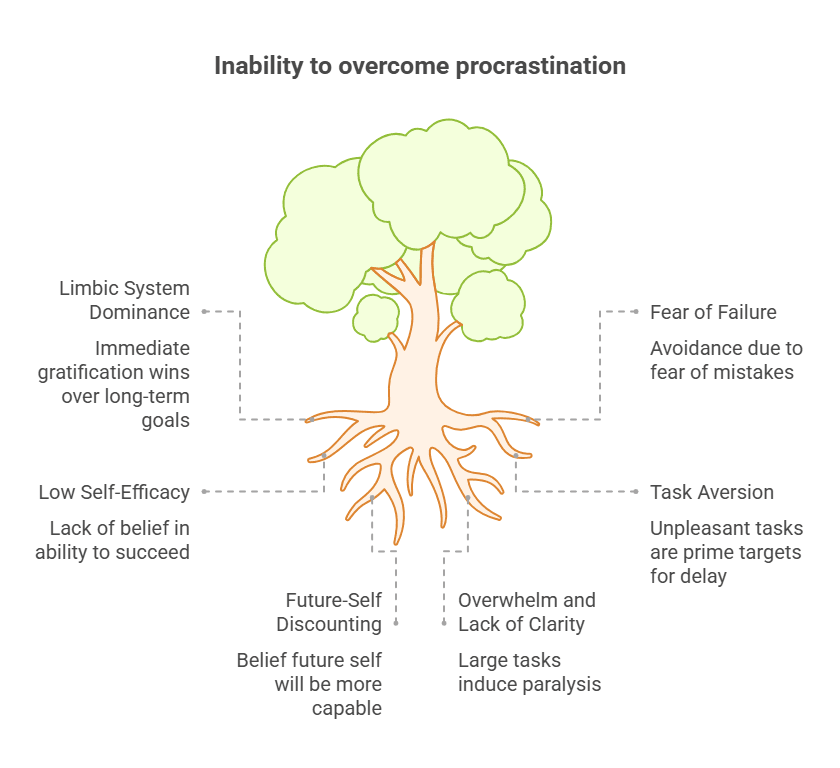
The roots of this disconnect are often deeply psychological, not just a lack of willpower:
- Fear of Failure or Judgment: This is a powerful driver for avoidance. If you believe your performance must be perfect, the fear of making a mistake can lead to paralysis.
- Perfectionism: The belief that anything less than flawless execution is total failure. This can lead to endless tweaking and delaying launch, as seen in startup founders who endlessly refine app features to avoid the “imperfection” of sales copy, resulting in delayed product launches and lost market share.
- Low Self-Efficacy: A lack of belief in your ability to complete a task successfully, which can be linked to imposter syndrome.
- Lack of Intrinsic Motivation: The task feels meaningless, boring, or misaligned with personal values.
- Task Aversion: The task is genuinely unpleasant, ambiguous, or unstructured, making it a prime target for delay.
- Future-Self Discounting: The belief that “Future You” will be more motivated, energetic, skilled, or have more time, discounting the reality of accumulated stress.
- Overwhelm and Lack of Clarity: A task feels so large and complex that it induces paralysis, as experienced by a thesis student facing a 25-page proposal without knowing where to begin.
These internal narratives manifest in significant costs:
- Slower Work Output: Procrastination fragments focus, increasing project completion time significantly.
- Compromised Quality: Rushed tasks breed mistakes, with some studies showing last-minute work contains 30% more errors.
- Missed Deadlines and Opportunities: This can damage client trust and professional reputation.
- Increased Stress, Anxiety, and Guilt: The immediate relief of avoidance is replaced by long-term distress, anxiety, and self-recrimination.
- Stifled Growth: Avoiding challenging tasks prevents skill development and personal evolution.
Part 2: Dismantling the Monolith: Strategic Time Management for Action
The antidote to overwhelming tasks and the procrastination habit lies in systematic task deconstruction and meticulous planning. This transforms daunting mountains into manageable foothills, making action inevitable.
- Crafting Your Procrastination-Proof Timeline: A clear plan is your defence against procrastination. It provides clarity, builds accountability, and frees up mental energy.
- Deconstruct the Beast: Start with the ultimate outcome (e.g., “Deliver final branding package”). Break it into major phases (e.g., Research & Discovery, Concept Development). Then, break each phase into key milestones – significant accomplishments within a phase. Finally, decompose milestones into specific tasks – concrete, actionable steps that take 15-90 minutes and require no further decomposition. The smaller and more concrete the task, the lower the barrier to starting.
- Decomposition Frameworks: Use Mind Mapping for visual brainstorming, Work Breakdown Structure (WBS) for hierarchical organisation, the “Next Action” Method for identifying immediate physical steps, or Kanban Boards (e.g., Trello) to visualise tasks in columns like “To Do, Doing, Done”.
- Estimate Realistically & Backward Plan: Be ruthlessly honest about how long each task will actually take, including buffer time for interruptions and the unexpected. Then, starting from your final, non-negotiable deadline, work backwards, assigning dates and deadlines to each phase and task. Crucially, build in significant buffer time (10-25%+) to absorb shocks and prevent cascading delays
- Time Blocking: Allocate specific, non-negotiable time slots in your calendar for each task. Treat these as sacred appointments with yourself. For instance, instead of “Work on report Tuesday,” block “9:00 AM – 10:30 AM: Draft Introduction Section”. Include blocks for breaks and checking emails to contain distractions.
- Review & Adapt Religiously: Your timeline is a living document. Conduct daily reviews (5-10 minutes) to adjust time blocks and note completed tasks, and weekly reviews (30-60 minutes) to assess progress against the overall timeline. This is not failure; it is intelligent course correction.
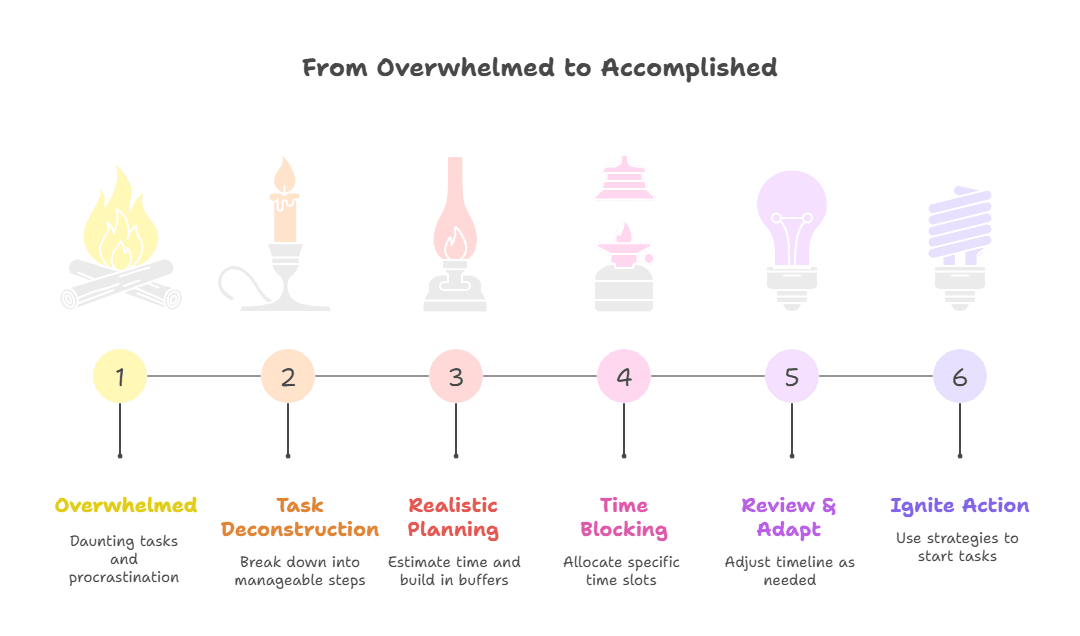
- Igniting Action & Building Momentum: Even with a perfect plan, starting can be hard. These strategies make initiation inevitable:
- The 5-Minute Rule: Commit to working on a task for just 5 minutes, giving yourself permission to stop afterwards. This reduces perceived threat, bypassing initial resistance, and often builds momentum to continue longer.
- Implementation Intentions: Transform vague intentions into concrete, pre-planned responses to specific cues. Use the “If-Then” formula: “IF [Situation/Time], THEN I will [Specific Action]”. For example, “IF it is 9:00 AM on Tuesday, THEN I will open my research folder and spend 5 minutes searching the database for seminal papers”.
- Habit Stacking: Attach a new micro-task to an existing habit. “After I pour my morning coffee, I will spend 5 minutes outlining the next section of my report”.
- Only-Next-Step Focus: Consciously narrow your attention to the single, immediate next physical step you’ve defined. Actively ignore the larger project to minimise cognitive load and anxiety.
- Priming the Workspace: At the end of a session, set up everything needed for the next micro-task. This reduces friction and makes starting the next session effortless.
Part 3: Unshackling from the Digital Leash: Mastering Controllable Distractions
In our hyper-connected world, digital distractions are a primary threat to focus and mental clarity, often leading to overwhelm and procrastination. Many of us suffer from nomophobia, intense anxiety when separated from our devices.
- The Hidden Cost of Constant Connection: Our brains are simply not designed for marathon focus in a digitally saturated environment.
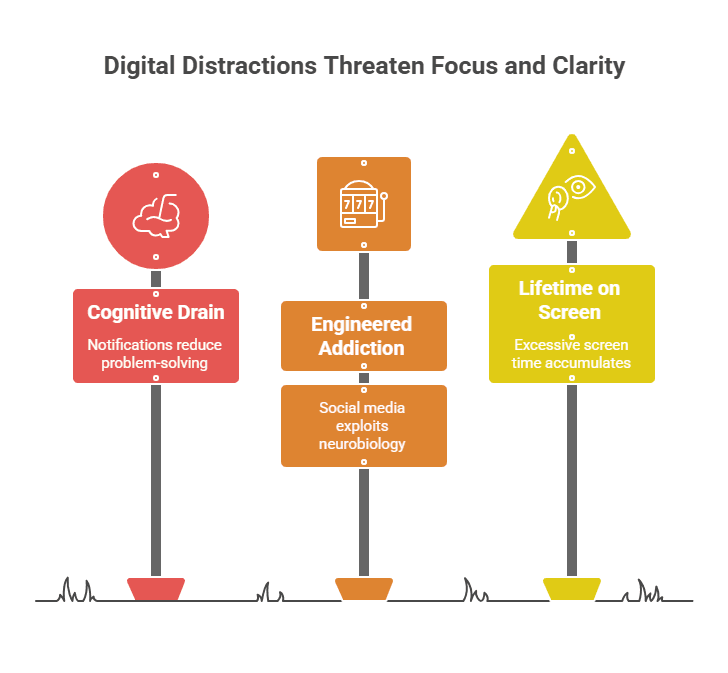
- Cognitive Drain: Background app notifications can equate to a 10 IQ point reduction during critical tasks, and continuous context switching can lead to a 40% drop in complex problem-solving efficiency. Studies show the mere presence of devices, even if unused, can reduce recall accuracy by 20% – known as the “brain drain effect”.
- Engineered Addiction: Social media platforms are designed to exploit our neurobiology. They use variable reward schedules (like unpredictable “likes”) that trigger dopamine surges, similar to slot machines. Endless scroll architecture deliberately removes stopping cues, inducing a flow state that keeps you hooked. This “validation economy” activates the brain’s reward centre, the nucleus accumbens, leading to obsessions with likes and shares. Whistleblowers have even stated that these systems were built knowing they would erode mental health.
- Lifetime on Screen: The average US adult spends over 10 hours daily on screens, accumulating to 8.7 years of waking life. This has significant physical tolls like digital eye strain and “text neck”.
- The Reclamation Framework: Building Digital Resilience: True freedom from digital overload comes from strategically rewiring your relationship with technology.
- Behavioral Rewiring: The Hobby Prescription: Hobbies are not distractions; they are cognitive antidotes. Engaging in tactile creation or playing instruments boosts calming neurotransmitters (GABA) significantly more than passive scrolling. Activities like woodworking, rock climbing, or memoir writing can engineer flow states and rebuild attention spans. By auditing wasted screen time and replacing scroll sessions with purposeful hobbies, individuals can significantly reduce anxiety and reclaim hours.
- Digital Surgery: The App Elimination Protocol:
- Audit & Triage: Identify your top time-sinks. Immediately delete infinite scroll apps (TikTok, Instagram Reels). Neuter notifications from essential messaging apps like Slack or WhatsApp. Restructure your phone by moving essential utilities to the home screen and burying social media apps in folders, adding biometric locks or 24-hour “download cool-off” rules.
- Withdrawal Plan: Use grayscale mode (reduces dopamine hits by 43%) for the first few days. Install app blockers (e.g., Freedom) to block distracting websites during focus hours.
- Environmental Design: Spatial Boundaries for Digital Sobriety:
- The 10-Foot Rule: Keep phones at least 10 feet away during meals, deep work sessions, and intimate conversations. This reduces indigestion and increases task completion speed and empathy recall.
- Bedroom Sanctuary Protocol: Charge your phone in a hallway or another room, not beside your bed. Use a standalone alarm clock and install red-light bulbs to promote melatonin. Place an analog book on your nightstand as an alternative input.
- Workplace Arsenal: Utilise “Focus Pods” or soundproof phone booths for scheduled digital checks, or even enterprise-grade signal jammers in meeting rooms to enforce phone-free zones.
- The Liberation Psychology: Shifting Your Digital Identity:
- Move from FOMO (Fear Of Missing Out) to JOMO (Joy Of Missing Out). Actively curate “analog adventures” and track the experiences gained (e.g., “Learned guitar chord” is more valuable than “Saw influencer post”).
- Adopt a “Device as Tool, Not Toy” mindset. Apply the “surgeon’s rule” – only remove your phone from your pocket for pre-defined tasks, treating it like a tool for a specific job, not a source of endless entertainment.
In essence, overcoming procrastination and digital distractions is about fundamentally reshaping your relationship with your time and attention. By understanding the intricate battles within your brain and consciously designing your environment and habits, you empower yourself to achieve sustained focus and profound mental clarity. This approach allows you to step away from the endless scramble and truly unshackle your mind, enabling you to beat stress, stay focused, and feel better, anytime and anywhere.
Visit Neuroboost AI today and reset your mind in 5 minutes a day